
Where Do You Wander When You Wonder?
On rabbit holes, mathematical mysteries, and finding peace in the messy middle
I'm a wonderer and a wanderer. I wander and then I wonder.
I'm okay with that taking time. Letting a thought sit in the back of my mind until I stumble onto something useful. The only downside is clutter. Thoughts pile up when you don't "complete" them, and completing a thought often means learning something new, researching, experimenting. That takes time. So in the past, I'd pause mid-wonder, half-finished.
Wondering with only half the information makes for fun fiction, but not always progress.
AI changed that equation. Now I can accelerate the wander-wonder cycle to a better stopping point. When I wonder, I have a better place to wander.
The Physical and the Mental
In physical space, my wander is usually a walk. Nature. The backyard. Letting the sun bake thoughts into me while my mind drifts elsewhere.
But in my head? I could be in any number of alternate realities. Realities that haven't been built yet. Tech that doesn't exist. Processes we haven't invented. New ways of living that nobody's articulated.
Until AI, those mental pathways always had a cap on exploration. You'd hit a wall where the research required exceeded the time available, and the thought would go dormant.
Now I can explore at the speed of AI. (And sometimes the hallucinations, but that's part of the adventure.) Rabbit hole thoughts become genuinely enriching when you have all the right data supporting the venture.
Down the Rabbit Hole: Lychrel Numbers
One of these rabbit holes is the concept of lychrel numbers.
Here's the idea: take any number. Reverse its digits. Add them together. For most numbers, if you keep doing this, you eventually land on a palindrome. A number that reads the same forwards and backwards.
Try 87:
87 + 78 = 165
165 + 561 = 726
726 + 627 = 1353
1353 + 3531 = 4884
Palindrome. Four iterations.
But some numbers just... don't. Take 196. Mathematicians have run it through billions of iterations. Still no palindrome. We don't know if it ever will converge. It might. It might not. That's a lychrel number. Or at least a candidate for one.
I'd been fascinated by 196 for years. I'd tried to solve it in SQL, in Node.js, with various ETL tools. Brute force iterations hoping to find the answer. But the pattern of what was happening across all these numbers? That lived only in my head.
Then Claude helped me write a Python script to finally visualize it.
What I Found Wasn't What I Expected
I was looking for some sort of complex spiral pattern. A correlation between iterations, starting number, and convergence. Instead, I found something more abstract. More universal.
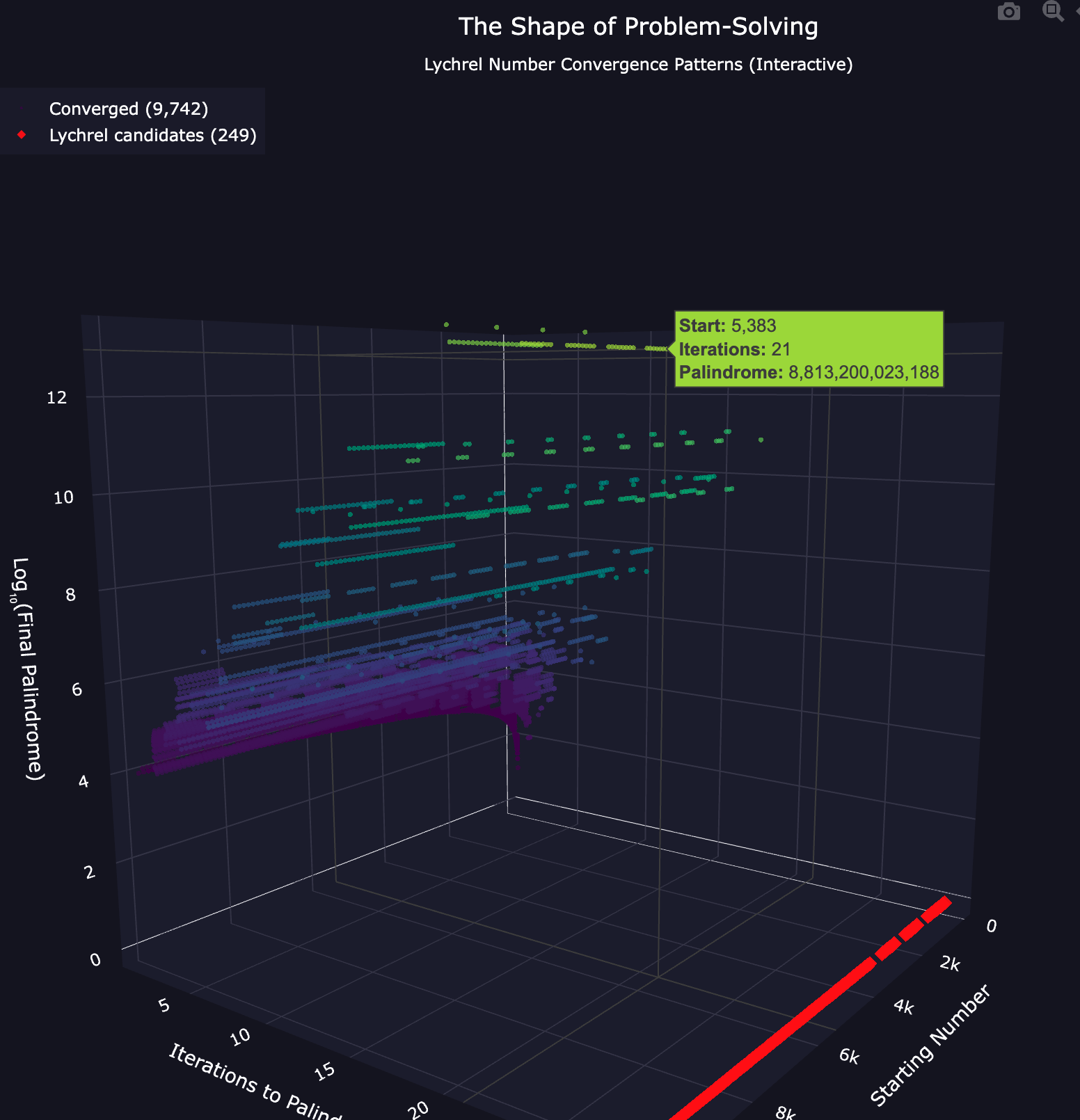
Look at those horizontal lines. Each one represents a "plateau." A set of numbers that all converge in the same number of iterations. Most problems are easy: they solve in one, two, three steps. That's the dense band at the bottom. As you move up, the plateaus get sparser, the gaps between them wider.
And then there are the red triangles. The lychrel candidates. Numbers like 196 that float at the edge of the visualization, never converging, iterating toward something we can't see.
I started to see this as the pattern of problem-solving itself.
What Infinity Actually Feels Like
Some problems are easy. Even as the numbers grow, given previous knowledge, most are solvable. You stand on plateaus of existing solutions and reach for the next one.
But then you hit a 196.
Something where billions of iterations produce no answer. Where every tool you throw at it just generates more complexity. Where the next plateau is so far away you can't see it at all.
Maybe this is what infinity really feels like.
Infinity is a perspective problem. When you can't see the next plateau, the gap feels infinite. But it's not. It's just the messy middle.
Those gaps are where new technologies emerge. New frameworks. New ways of thinking that solve many problems at once. And when we finally get it right, we have new plateaus to stand on.
The number 89 looks simple enough. But it takes 24 iterations to reach its palindrome: 8,813,200,023,188. Twenty-four steps through the messy middle before arriving somewhere stable. If you quit at iteration 20, you'd think it was impossible.
Still Human in the Middle
This is what AI enables. Not skipping the messy middle, but moving through it faster. Better data for the wandering. More fuel for the wondering.
But one thing doesn't change: we still get the human experience of being in that middle. The confusion. The uncertainty. The not-knowing-if-we're-close.
That's not a bug. That's the texture of hard problems. That's what it feels like to be alive and thinking and trying to figure things out.
It's okay to be confused in the messy middle. We'll figure it out. We always do. And the plateau we're standing on right now? Someone else once thought it was impossible too.
So, where do you wander when you wonder?