
The Distance Between Zero and One Is Infinity
The people declaring AI wrappers dead are counting in whole numbers. The builders are living in the decimals.

Every few weeks it happens again. A platform ships a new feature and the internet fills up with the same headline wearing different clothes: "X wrapper is dead." "Y just got killed." "Why would anyone build Z now?"
This time it was Claude rolling out co-work with scheduled dispatch and channels. And right on cue, the takes started. Every agent management tool is dead. Anything that sits on top of an AI platform is dead, has always been dead, will forever be dead the moment the platform catches up.
On the surface, sure. I get it. If you squint, the new native feature looks like the thing someone else built. So the thing someone else built must be pointless now, right?
I think the people writing those takes just haven't been far enough in the weeds yet.
The Old World Counted in Whole Numbers
There's a mental model most people are still running, and it comes from the world we grew up building software in. The deterministic world. In that world, one tool does one thing. This is the CRM. That is the project manager. Here is the email client. There is the spreadsheet. Each product occupied a clearly defined integer on the number line, and your business model had to fit the way that product worked because that was the only way it worked.
You didn't have a lot of choice. You bought the thing that did the thing, you learned its opinions, and you shaped your workflow around them. If you needed something between two integers, too bad. That space didn't exist. You couldn't build there even if you wanted to, because building software was expensive and slow and required teams of people and months of runway.
That world made the "dead" takes make sense. If the platform occupies integer 1, and you built something at integer 1, then yes. You're redundant. Pack it up.
But that's not the world we're in anymore.
The Turn
Here's a mathematical fact that never stops being strange to me: the distance between zero and one is infinite. Not metaphorically. Literally. Between 0 and 1 there are infinite real numbers. 0.1, 0.01, 0.001, and so on forever. Between any two of those, infinitely more. The density is bottomless.
This is the part the naysayers are missing. They're still counting in whole numbers, looking at the number line and seeing integer positions. Platform does this. Wrapper does this. Same integer. Dead.
But the builders? The builders are living in the decimals.
When software can be built fast — and I mean genuinely fast, like a weekend for something that used to take a quarter — the space between any two products becomes infinitely divisible. People don't just want "the thing." They want their flavor of the thing. They want it shaped to their workflow, their team size, their budget, their specific combination of needs that no platform team is going to prioritize because they're building for the median user.
Think about task management. We have Notion. Asana. Monday. Todoist. Evernote. Linear. Jira. ClickUp. Each one is a whole number on the line. And each one has gotten so bloated trying to be all the numbers at once that learning the tool becomes its own project. You're paying for fifty features to use three. You're sitting through onboarding flows for capabilities you'll never touch.
So what happens? Someone builds a simpler thing. Not because they don't know Notion exists, but because they need 0.3, not 1. They need project management without the wiki. Or a task list that talks to their repo without the Gantt charts. Or notes that are just notes without the relational database underneath. These aren't worse products. They're different decimals.
Full Disclosure
I should be honest here. I've built things that sit on top of AI platforms. Tools, products, experiments. So yes, I have skin in this game. Things I've built get declared dead on a semi-regular basis.
But I've also built games, websites, design systems. I've watched this pattern from enough angles to know it's not just about defending my own work. The "wrapper is dead" take is wrong at a structural level. It misunderstands what's happening.
What's happening is that the number line between any two points just became infinitely dense. And the cost to build at any point on that line dropped by orders of magnitude. That combination changes everything.
Doesn't the Platform Always Win?
This is the obvious counterargument, and it's worth sitting with.
Sometimes the platform does win. Sometimes a feature ships and a startup's entire value proposition evaporates overnight. That's real and it's brutal when it happens.
But here's what I've noticed: platforms often chase the innovation of small teams. The wrapper builders, the indie hackers, the people living in the decimals. They find the need first. They validate that 0.37 is a real place people want to be. Then the platform builds their own version of it, and everyone says the original was pointless. But someone had to go there first. Someone had to prove the coordinate existed.
And even when the platform catches up, the problems don't stop getting more complex. They compound. The platform builds the 80% version for the 80% case, because that's what platforms do. The remaining space is still infinite. Different workflows, different integrations, different cost structures, different opinions about how the thing should feel to use.
The flavors emerge as higher-level simplicity entry points. Maybe you just need project management. Maybe just a simple task list. Maybe just notes integration without paying for fifty features you'll never use. Maybe you want to save your business X dollars per seat by building exactly the subset you need. Every one of those "maybes" is a decimal point someone can build at.
Where's the Line Between Meaningful Decimal and Noise?
This is the harder question. If the space is infinite, how do you know you're building something real and not just making noise at some random coordinate?
Honestly? The line gets redrawn over and over. We'll know it when we see it. That's an unsatisfying answer, but it's the true one.
I've been thinking about this through a strange lens lately. I'm fascinated by lychrel numbers, this mathematical concept where you take a number, reverse its digits, add them together, and repeat. Most numbers eventually land on a palindrome. But some, like 196, just don't. Billions of iterations and still no convergence. We don't know if it ever will.
A while back I used Claude to help me visualize what was happening across all these numbers. What I found wasn't the spiral pattern I expected. It was something more abstract. More like a map of problem-solving itself.
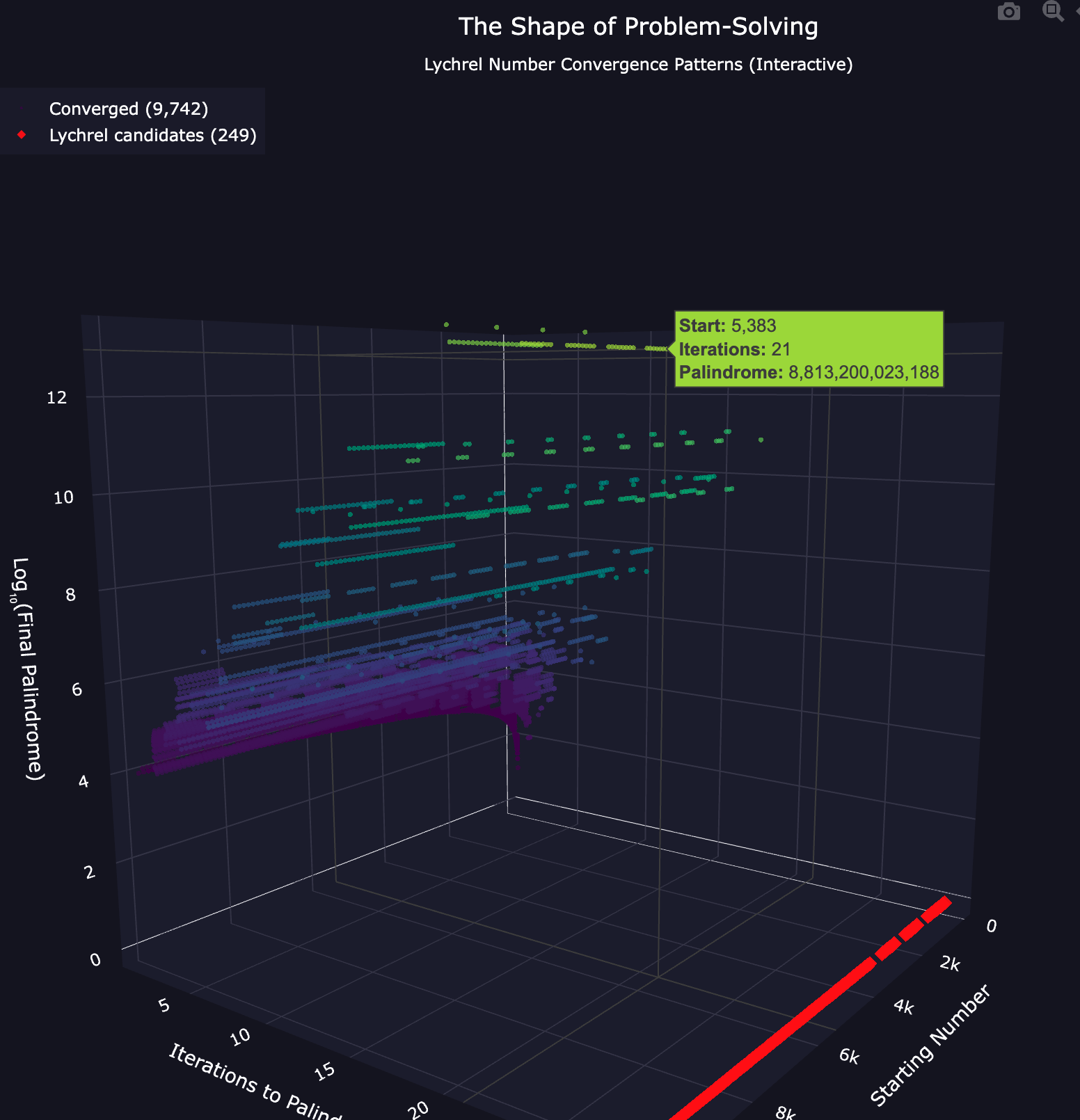
The visualization showed horizontal bands. Plateaus where clusters of numbers all converge at the same step count. Easy problems at the bottom, dense and predictable. As you move up, the plateaus get sparser. The gaps between them widen. And at the edges, the lychrel candidates float in open space, iterating toward something nobody can see.
I started to see those horizontal bands as the solutions we've already found. The known decimals. The places where lots of problems get solved by the same approach. And the gaps between the plateaus? That's the messy middle. The space where new understanding is forming, where the next breakthrough is somewhere ahead but you can't see it from where you're standing.
New technology emerges in those gaps. It solves many problems at once, and suddenly there's a new plateau to stand on. But before it arrives, you're wading through uncertainty. You're building at coordinates that might matter or might not. You're running iterations without knowing if convergence is one step away or a billion.
The exploratory builders are doing that work for the benefit of everyone else. They're out in the decimals, testing coordinates. Most of what they build won't survive. But some of it will find a plateau, and that plateau becomes the ground the next generation builds on.
The Messy Middle
Maybe the real thing I want to say is this: it's okay to be in the messy middle.
The people writing "wrapper is dead" posts are standing on a plateau and looking out at the gap and calling it empty. But the gap isn't empty. It's full of builders running iterations. Some of them are on step 3 of a problem that converges at step 24. If you looked at step 20 you'd think it was impossible. But step 24 is 8,813,200,023,188 and it's a palindrome and it was always going to work. You just couldn't see it from where you were standing.
The number 196 might never converge. Some problems might actually be infinite. But you don't know that until you've done the work. And even the work that doesn't converge teaches us something about the shape of the problem space.
This is the part of the AI era that nobody wants to sit with. The speed is intoxicating. The platforms are shipping features at an insane pace. Every week the landscape shifts. And the temptation is to look at all that motion and declare that the only safe place to build is on the platform itself.
But the distance between any two platform features is infinite. And the people who understand that? The ones comfortable with the density of the space, who can see that every decimal point is a potential product, a potential business, a potential solution to a problem the platform team hasn't even identified yet? Those are the ones building the future.
They're not wasting their time. They're wandering in the space between the known numbers, wondering what they'll find.
Where Do You Build?
I'm not going to pretend I have the map. Nobody does. The whole point of infinite density is that you can't chart it in advance. You have to go there and see what's real.
What I know is this: the naysayers are counting in whole numbers in a world that now has infinite decimals. The cost of being wrong at any given coordinate has dropped dramatically. The cost of not exploring has gone way up. And the messy middle, that uncomfortable space between the plateaus where nothing is proven and everything is uncertain? That's where all the interesting work is happening.
Some of those wrappers that got declared dead last week? They'll be dead. Some of them will find their decimal and thrive in a space the platform never serves well. And some of them will get acquired, because the platform realized that coordinate was worth occupying after all.
The distance between zero and one is infinite. Start building somewhere in there.
I'm Lando, founder of Lando Labs. I build apps, and I help teams find their way out of the messy middle. Occasionally I fall down a mathematical rabbit hole and come back with a metaphor.